
Blog

  • Duff’s Ditch: The Joke That Saved Winnipeg (Red River Floodway)

    Duff’s Ditch: The Joke That Saved Winnipeg (Red River Floodway)

    They laughed at it for years.

    They called it Duff’s Folly, and said it would be about as useful as building the pyramids — a giant, expensive monument that would never protect a single home. The plan sounded crazy: dig Winnipeg a second river, just in case.

    Decades later, that joke became the only thing standing between this city and the flood of the century.

    The spring Winnipeg never forgot: 1950

    To understand why, picture Winnipeg in the spring of 1950. The river rose, and kept rising, and stayed above flood stage for fifty-one days. More than ten thousand homes filled with water. Around a hundred thousand people — roughly one in every three in the city — packed what they could and left, in the largest evacuation Canada had ever seen.

    Winnipeg learned the hardest lesson a city can learn: its own river could empty its streets whenever it chose.

    One man would not drop the idea

    One man simply would not drop the idea: Dufferin Roblin — everyone called him Duff. He pushed the floodway while still leading the opposition, and when he became premier in June 1958, he pushed it through. Ottawa agreed to pay up to sixty cents of every dollar.

    But Manitoba did not even have a million people back then, and to the critics, this looked like a premier building himself a pyramid: Duff’s Ditch.

    Digging a second river

    The digging started anyway, in the fall of 1962. For five and a half years, crews carved a channel forty-seven kilometres long around the east side of the city, moving seventy-six and a half million cubic metres of earth — more than was moved for the Suez Canal. At the time, only the Panama Canal project had moved more.

    It finished in March 1968, on time and under budget, for sixty-three million dollars.

    How a sleeping river works

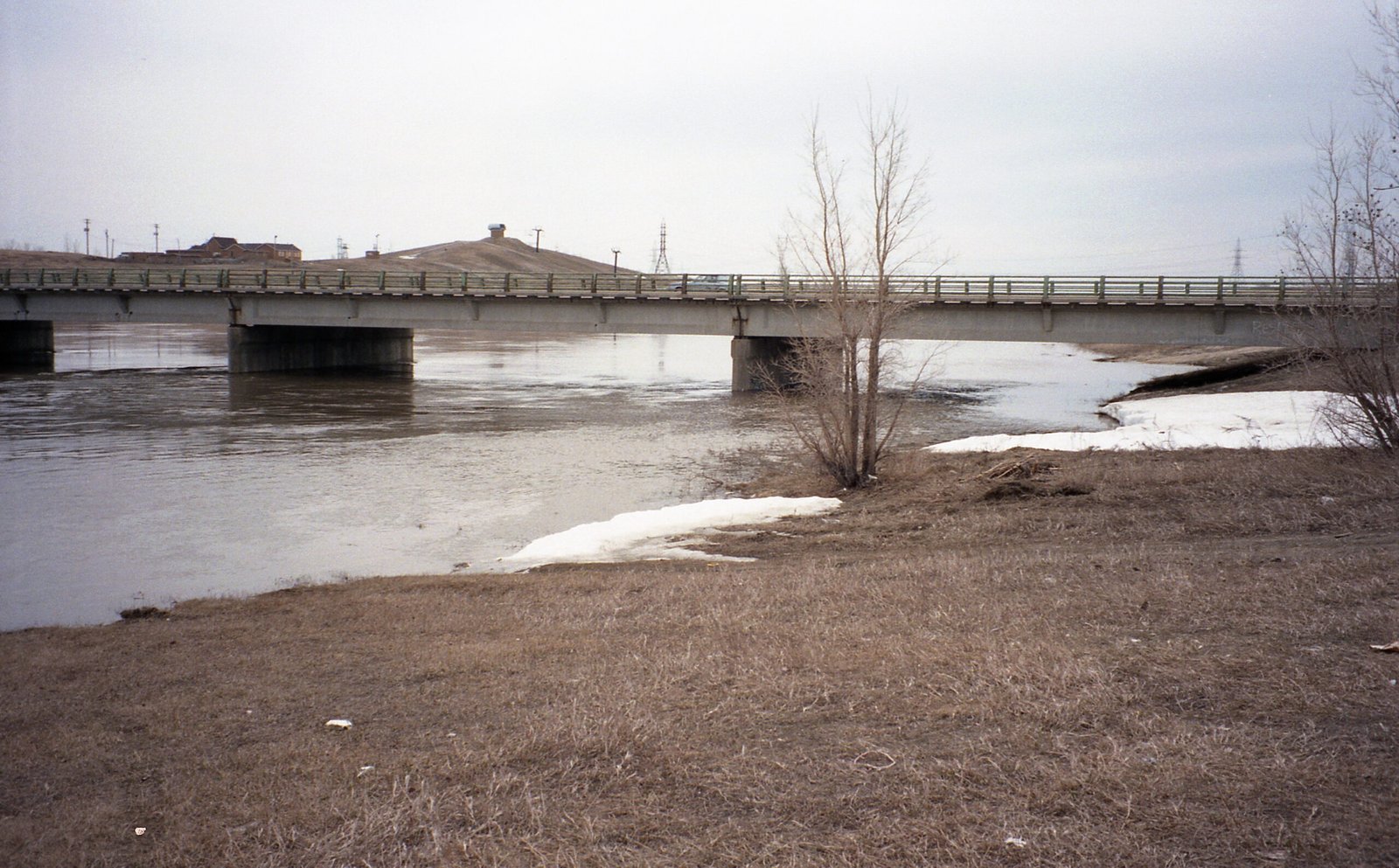
    Now here is the strange part. This second river is asleep almost all the time. Most of the year it is just a wide, dry, grassy ditch.

    Its famous gates are not even in the channel: they lie flat on the bottom of the real river, south of the city, like a trapdoor nobody notices. When a flood comes, the gates lift and hold the river back, just enough. The backed-up water spills sideways into the waiting ditch, takes a forty-seven-kilometre shortcut around the city, and joins the Red again below Lockport.

    The ditch only wakes up for the extra water — the part the city cannot handle.

    It was formally opened in October 1968, but Duff Roblin was no longer premier. Somebody else got to cut the ribbon on the ditch that carried his name. It went to work the following spring: by 2022, it had been needed in thirty-five of its fifty-three years.

    1997: the night it was built for

    Then came the night it was built for. The flood of 1997 was the biggest since 1826, with half again as much water as 1950. South of the city, whole towns held out inside ring dikes, like little islands, while some twenty-eight thousand Manitobans were forced out of their homes.

    On one desperate night, the people running the floodway broke their own rulebook to keep Winnipeg safe.

    Without the ditch, the water would have stood two and a half metres over the city’s dikes and flooded some two-thirds of Winnipeg. Instead, only about thirty Winnipeg homes got wet.

    But 1997 was not free: the damage on the Canadian side of the valley ran to around five hundred million dollars, and Grand Forks, just across the border, with no ditch of its own, was devastated.

    Winnipeg’s answer: make the ditch bigger

    Winnipeg’s answer was very Winnipeg: make the ditch bigger.

    Not deeper — digging down would threaten the drinking water stored in the ground below — so they made it wider. Now it can carry more than twice as much water as the original, enough for a flood expected only once in seven hundred years.

    In 2000 it was named a National Historic Site of Canada. And in the fall of 2019, it did something it had never done before: it went to work in autumn.

    The joke that paid for itself hundreds of times over

    Since 1968, this ditch has prevented more than forty billion dollars in flood damage — repaying what it cost hundreds of times over.

    And yet most days you would never know it saved anything at all: people walk and cycle beside it on the Duff Roblin Parkway Trail, on dry grass, above a sleeping river.

    People laughed because it sounded like the pyramids: huge, pointless, built for one man’s glory. It turned out to be the exact opposite.

    Duff’s Ditch only looks pointless on the days Winnipeg stays dry — and those are exactly the days it is doing its job.

    Keep exploring:

    Sources: Manitoba government floodway materials · National Historic Sites of Canada (designated 2000) · Contemporary reporting and records of the 1950 and 1997 Red River floods

    Image credits: Red River Floodway from the air — JPark99, public domain · Duff Roblin portrait — Ashley and Crippen, via City of Toronto Archives, Attribution · Floodway map — Kmusser, CC BY 2.5 · Floodway gates, St. Norbert — Dano, CC BY 2.0 (all via Wikimedia Commons)
  • Manitoba Legislative Building: Fossils, Secrets and the Golden Boy

    Manitoba Legislative Building: Fossils, Secrets and the Golden Boy

    There’s a room in Winnipeg where a whisper comes back louder than a shout.

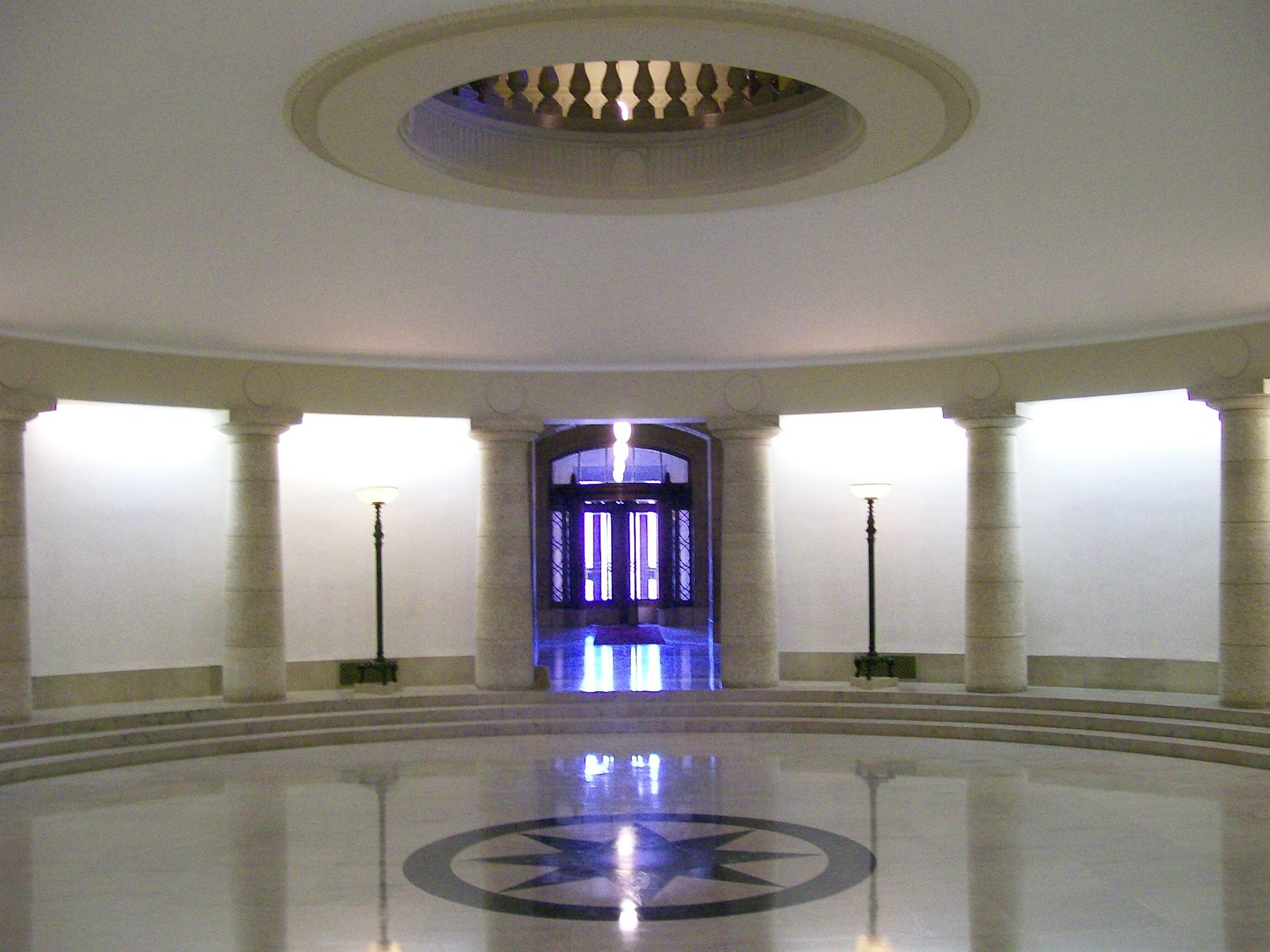
    It’s a round chamber beneath the dome of the Manitoba Legislative Building, and at its centre, set into the floor, sits an eight-pointed star of black marble — the Pool of the Black Star. Stand on it, speak softly, and your voice gathers somewhere above you and returns, full and round.

    That is not a legend. That is architecture. And it is only the first strange thing this building does.

    Watch the video: Winnipeg Built a Temple and Called It a Legislature

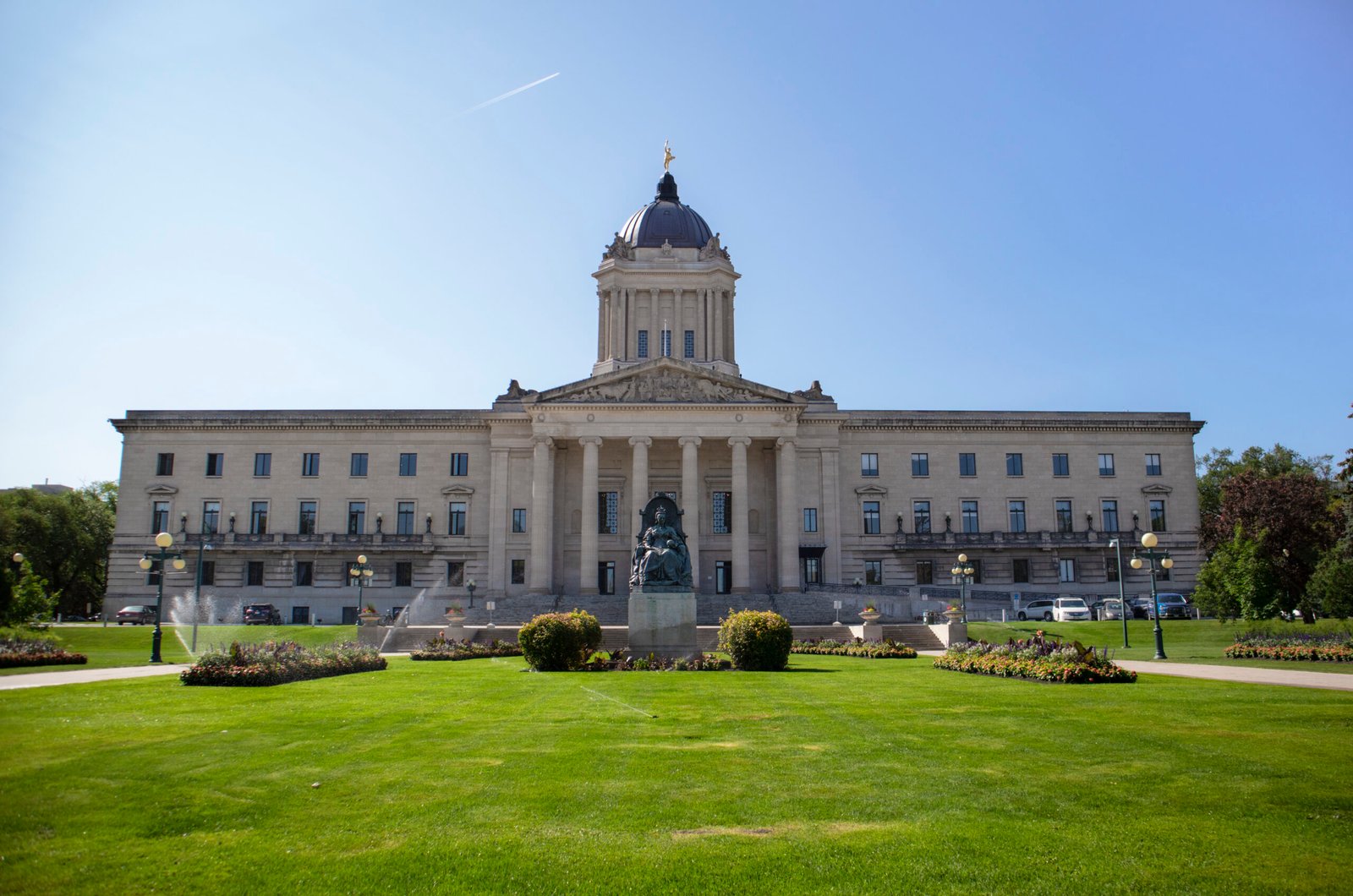
    Manitoba Legislative Building exterior

    A temple for a province barely forty years old

    In 1911, a booming Manitoba decided it needed a capital building to match its ambitions. The design competition drew sixty-seven entries from across the British Empire. The winner, Liverpool architect Frank Worthington Simon, didn’t draw an office building. He drew a temple — Greek columns, Roman gods, Egyptian sphinxes — for a prairie province barely forty years old.

    Construction began in 1913 and ran straight into the First World War, a contractor scandal that forced a royal commission and cost a premier his job, and the Winnipeg General Strike of 1919. The two-million-dollar budget swelled to a final bill of $9,379,000.

    Yet on July 15, 1920 — Manitoba’s fiftieth birthday — fifteen thousand people came to dance at the opening.

    The strike that delayed this building is a story of its own — and one of the most dramatic in Canadian history. Read: The Winnipeg General Strike of 1919: The Six Weeks a City Shut Down

    The walls are an ancient ocean floor

    Look closely at the walls, and the building gets older. Much older.

    It’s built of Tyndall stone, quarried at Garson — limestone formed when a tropical sea covered Manitoba some 450 million years ago. The sea never fully left. Its creatures are still in the walls: sponges, snails, squid-like cephalopods, trilobites. The largest fossil, near the east entrance, stretches a full metre across.

    Manitoba’s laws are debated, every day, inside an ancient ocean floor.

    Two bison, a frozen river, and a story no one can prove

    Inside, the Grand Staircase climbs in three flights of thirteen steps, cut from Italian Botticino marble. At its base stand two life-size bison, solid bronze, 5,000 pounds each, by the French sculptor Georges Gardet.

    How did they get in without gouging the marble? Ask a guide and you’ll hear the story: workers flooded the entrance, let the water freeze, and slid the giants inside on slabs of ice cut from the Assiniboine River.

    No document proves it. But this is Winnipeg in winter. You can believe it.

    Above it all, two faces watch each other across the hall: Medusa, whose gaze turned men to stone, and Athena, goddess of wisdom, keeping her in check.

    The Golden Boy crossed a war to get here

    Gardet also created the figure on the dome: a golden youth carrying wheat and a torch — 5.25 metres tall, 1,650 kilograms of bronze under the gold. His official name is Eternal Youth and Spirit of Enterprise. Winnipeg just calls him the Golden Boy.

    Cast in Paris in 1918, he crossed a wartime ocean — by some accounts riding as ballast in a commandeered ship — and rose to the dome in November 1919.

    In 2002, a crane finally brought him down. More than 114,000 people visited him at eye level in the Manitoba Museum. Then he went back up, freshly gilded — and that October, Queen Elizabeth II rededicated him herself.

    Is the building hiding a code? The honest answer

    So is the building hiding something?

    In 2007, Winnipeg researcher Frank Albo published The Hermetic Code. The sphinxes on the roof carry a carved prayer to Ra, the Egyptian sun god. On the east and west sides stand sealed chests, officially called War Chests, guarded by warriors and goddesses — and shaped, Albo says, exactly like the Ark of the Covenant. Count the steps and the stars, and the numbers 5, 8 and 13 keep appearing. Albo’s conclusion: Simon secretly rebuilt King Solomon’s Temple on the prairies.

    Here is the honest part: it remains a theory — famous, beloved, and unproven. No document has ever surfaced to confirm a code, and classical symbols were simply the fashion of 1913. The symbols are real. The secret may not be.

    A building that still goes to work

    What is certain: the building still works.

    Its chamber is the only one in Canada where members sit in a horseshoe. Its Blue Room still keeps a chair reserved for royalty. Its walls hold empty niches, waiting for statues that never came. And sealed inside somewhere is a time capsule from 2020, addressed to the year 2120.

    So next time you’re on Broadway, look up. The Golden Boy is still there, torch raised.

    And if you ever stand on that black star — whisper. The building will answer. It just won’t tell you everything.

    Keep exploring:

    Sources: Government of Manitoba, “100 Facts for 100 Years” · Frank Albo, The Hermetic Code (2007) — presented as theory · Manitoba Legislative Building tour and reference materials

    Image credits: Pool of the Black Star — public domain · Fossil in Tyndall limestone — Mike Beauregard, CC BY 2.0 · Grand Staircase — public domain · The Golden Boy — David Stanley, CC BY 2.0 (all via Wikimedia Commons)
  • The Winnipeg General Strike of 1919: The Six Weeks a City Shut Down

    The Winnipeg General Strike of 1919: The Six Weeks a City Shut Down

    On the morning of May 15, 1919, an entire city clocked out — and stayed out for six weeks.

    Winnipeg was one of the biggest cities in Canada, a booming railway hub on the Prairies. But that spring, more than thirty thousand of its workers walked off the job together: factory hands, firefighters, postal clerks, streetcar drivers. It became the most famous strike in Canadian history — the Winnipeg General Strike. And strangely enough, it started at a telephone switchboard.

    Watch the video: https://www.youtube.com/watch?v=NtceI8Pu2KA

    Why Winnipeg walked out

    To understand why, picture Winnipeg just after the First World War. Soldiers had come home to scarce jobs, soaring prices, and wages that hadn’t kept up. Workers in the building and metal trades wanted something basic: the right to bargain together, through their own councils, for better pay and safer conditions.

    Their employers refused to recognize those bargaining councils. So the city’s unions voted — overwhelmingly — to shut the whole city down.

    The day the city went quiet

    At eleven o’clock on May 15, the deadline hit. Among the very first out the door were the city’s telephone operators — the “hello girls” — who had left their switchboards at seven that morning.

    Within hours, Winnipeg fell quiet. No streetcars. No mail deliveries. Silent factories and shuttered shops.

    And yet the city didn’t collapse. The Central Strike Committee organized the essentials, and bread and milk still reached people’s doors — with the committee’s permission. In those first days the mood was almost festive: families gathered in parks to hear the latest news, certain they would win.

    Two Winnipegs, staring each other down

    Winnipeg’s business and political leaders were organizing too. They formed the Citizens’ Committee of One Thousand and painted the strike as something darker: a revolutionary conspiracy.

    Federal ministers came to town — and met only with the citizens’ committee. When the city’s own police refused to sign a no-strike pledge, they were fired and replaced by a rough force of “Specials,” armed with clubs.

    The two Winnipegs were now staring each other down.

    Bloody Saturday: June 21, 1919

    Before dawn on June 17, police raided homes across the city and arrested ten strike leaders. They were jailed at Stony Mountain Penitentiary, charged with seditious conspiracy.

    Four days later, returned soldiers announced a “silent parade” down Main Street to protest the arrests, and thousands came out.

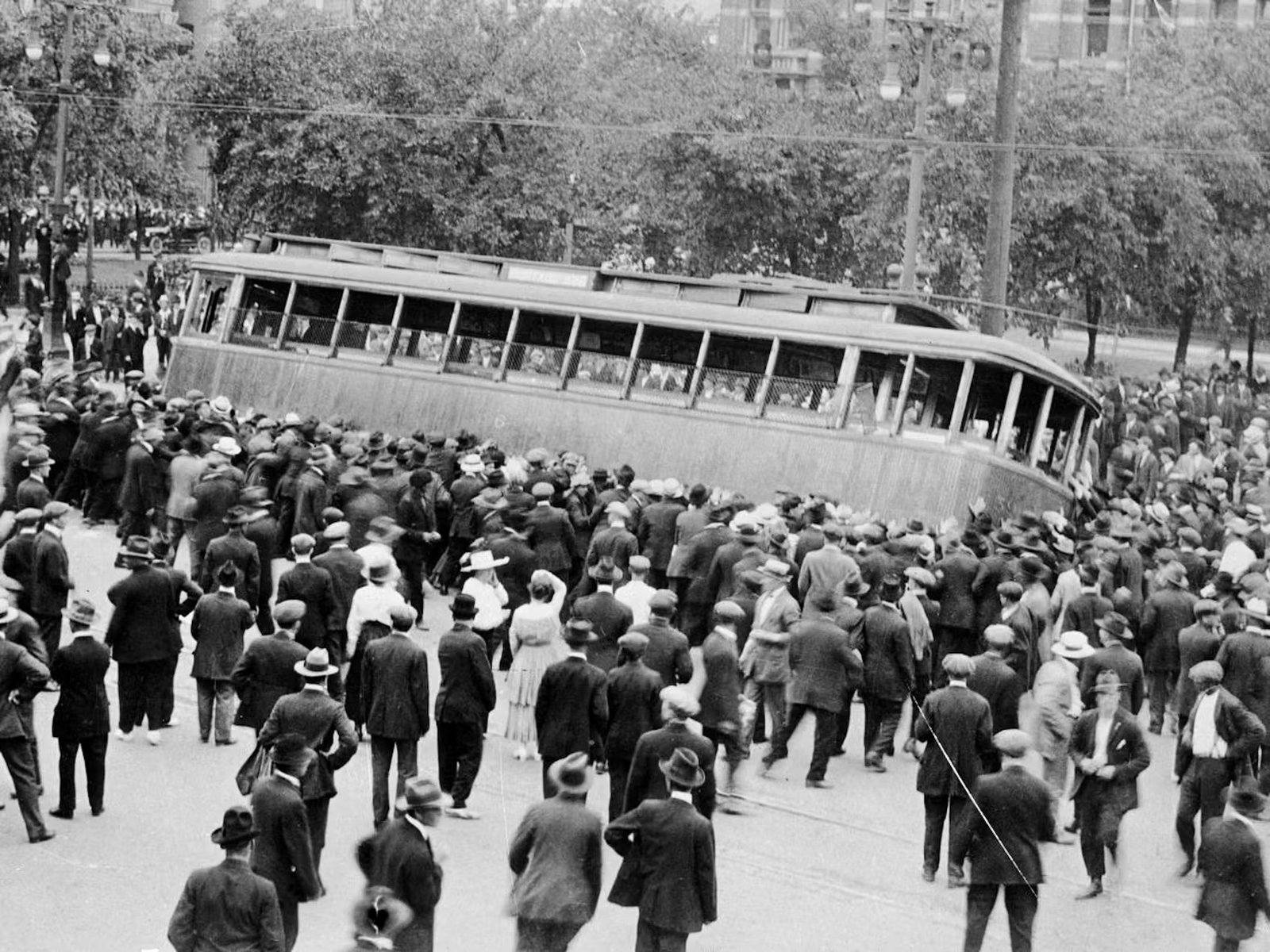
    What happened next is the part of this story Winnipeggers still lower their voices for. On the afternoon of June 21, outside City Hall, the mayor read the Riot Act. Mounted police charged into the crowd on horseback, swinging clubs. A streetcar driven by a strikebreaker tried to force its way down Main Street — and demonstrators stopped it, tipped it off its tracks, and briefly set it on fire.

    Then the Mounties opened fire.

    Two men were killed: Mike Sokolowski and Steve Szczerbanowicz. About thirty more people were injured, and ninety-four were arrested that day. Soldiers patrolled the downtown streets that night.

    The day became known as Bloody Saturday.

    The strike ends — and the twist

    Fearing more bloodshed, the committee called the strike off on June 25. At eleven in the morning on June 26 — exactly six weeks after they had walked out — Winnipeg’s workers went back to their jobs.

    In the short term, the strike had lost. Its leaders stood trial, several went to prison, and many strikers lost their jobs.

    But here’s the twist: they hadn’t lost for long.

    In Manitoba’s 1920 election, labour candidates won eleven seats in the provincial legislature — four of them strike leaders, three of those still in jail when the votes were counted. One arrested editor, J. S. Woodsworth, was elected to Parliament in 1921. In 1932, he helped found the Co-operative Commonwealth Federation — the party that eventually became today’s New Democratic Party.

    Over the following decades, the rights those workers demanded — to organize, to bargain, to be heard — became the law of the land. Historians still call the strike a turning point in Canadian history.

    Those same years, a very different Winnipeg landmark was rising a few blocks away — a temple-like capital building whose construction ran straight into this strike. Read: Inside the Manitoba Legislative Building: Fossils, Secrets and the Golden Boy

    The streetcar that still glows

    Winnipeg never forgot. Walk along Main Street today, across from City Hall, and you’ll find a ghost made of steel and glass: a streetcar, tipped on its side, rising out of the pavement at Pantages Plaza.

    It was unveiled on June 21, 2019 — exactly one hundred years after Bloody Saturday — and at night, it glows.

    A whole city stopped for six weeks. A century later, Winnipeg still keeps its memory lit.

    Have you ever noticed that streetcar? And do you think a city could ever stand together like that again?

    Keep exploring:

    Sources: The Canadian Encyclopedia · Library and Archives Canada · University of Manitoba · Winnipeg Arts Council

    Image credits: Tipped streetcar, Main Street, 1919 — L. B. Foote, public domain · Crowd at the old City Hall — L. B. Foote, public domain · RNWMP on Main Street — Library and Archives Canada, public domain (all via Wikimedia Commons)