
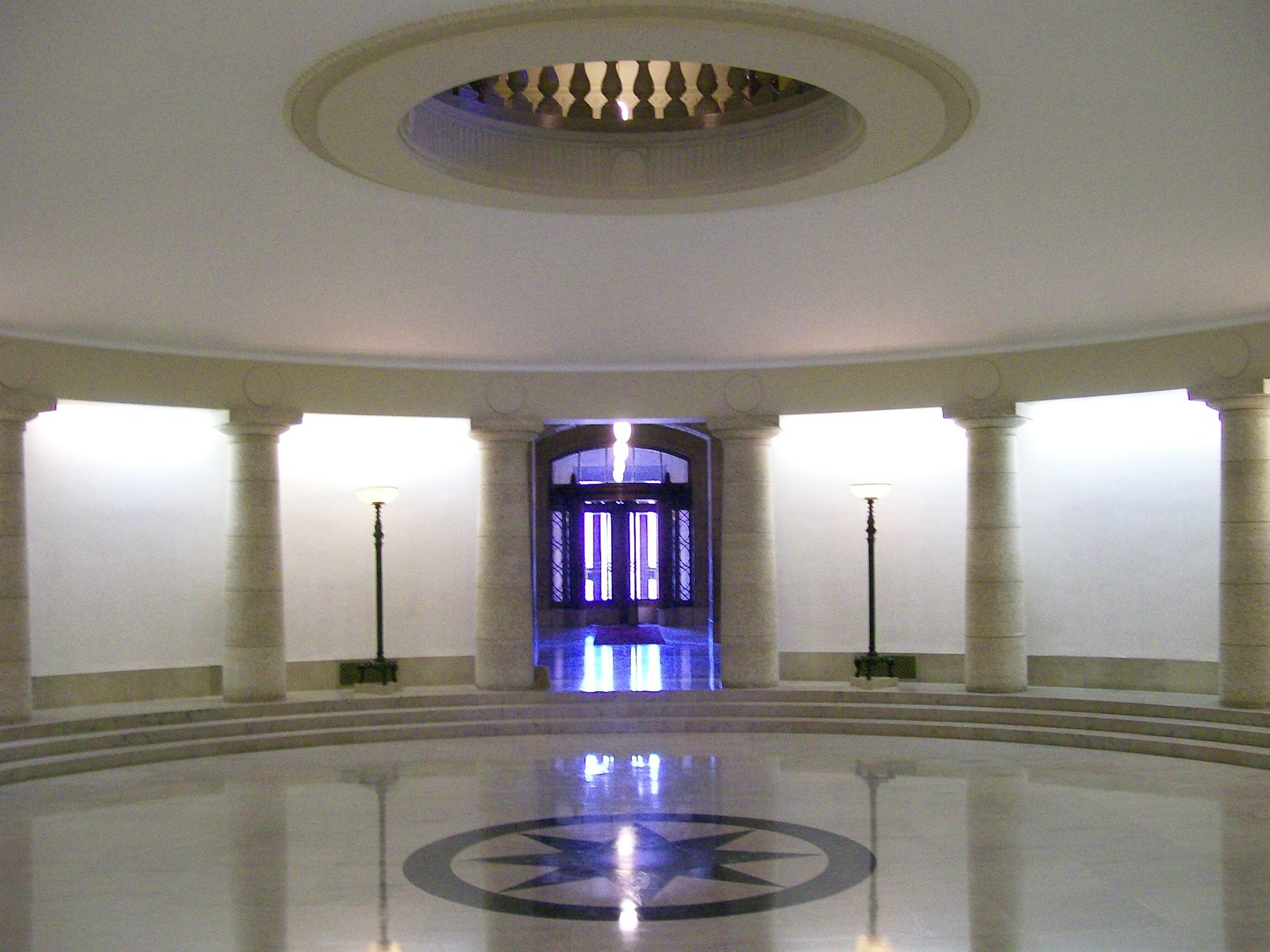
There’s a room in Winnipeg where a whisper comes back louder than a shout.
It’s a round chamber beneath the dome of the Manitoba Legislative Building, and at its centre, set into the floor, sits an eight-pointed star of black marble — the Pool of the Black Star. Stand on it, speak softly, and your voice gathers somewhere above you and returns, full and round.
That is not a legend. That is architecture. And it is only the first strange thing this building does.
Watch the video: Winnipeg Built a Temple and Called It a Legislature
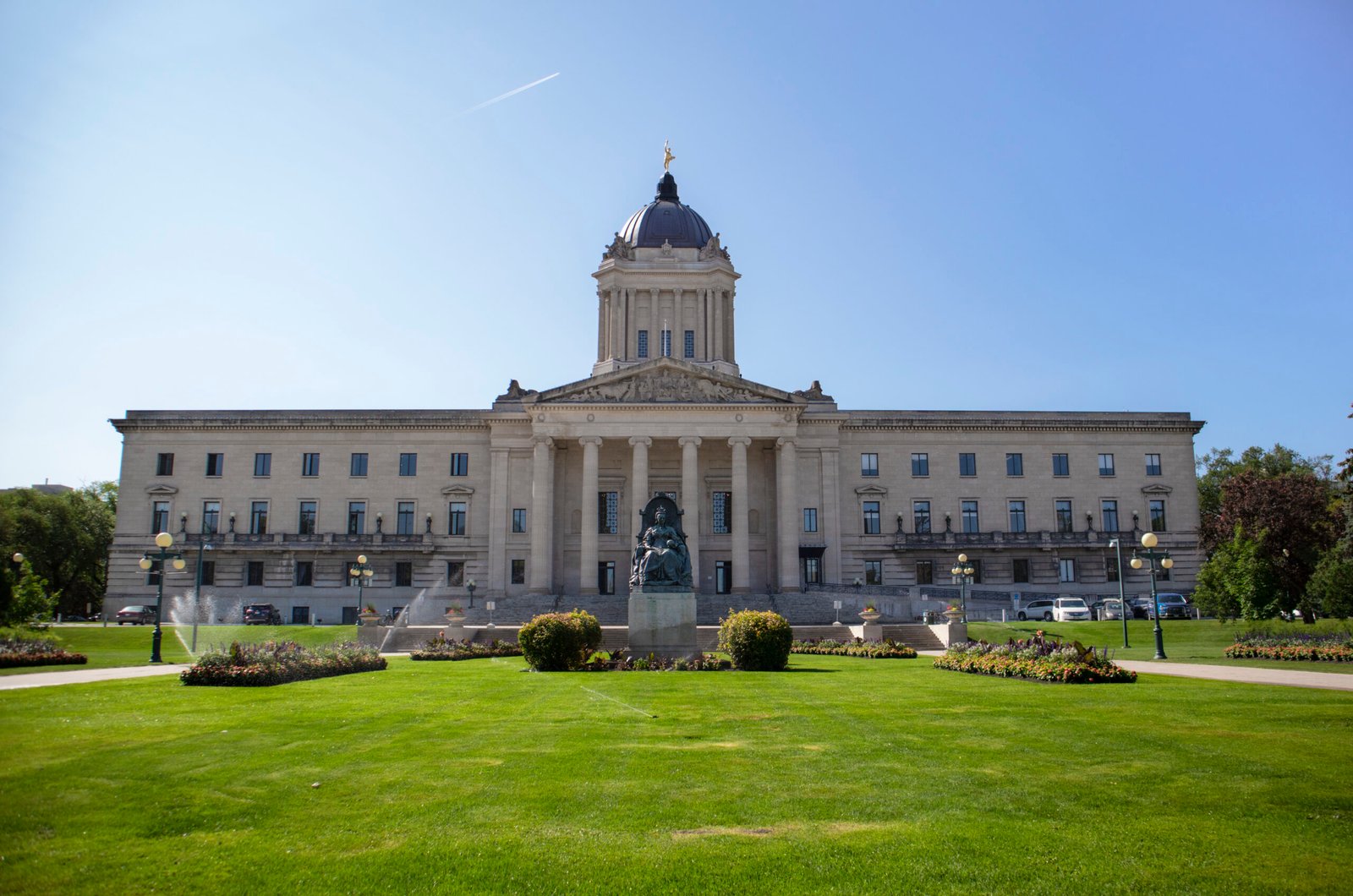
A temple for a province barely forty years old
In 1911, a booming Manitoba decided it needed a capital building to match its ambitions. The design competition drew sixty-seven entries from across the British Empire. The winner, Liverpool architect Frank Worthington Simon, didn’t draw an office building. He drew a temple — Greek columns, Roman gods, Egyptian sphinxes — for a prairie province barely forty years old.
Construction began in 1913 and ran straight into the First World War, a contractor scandal that forced a royal commission and cost a premier his job, and the Winnipeg General Strike of 1919. The two-million-dollar budget swelled to a final bill of $9,379,000.
Yet on July 15, 1920 — Manitoba’s fiftieth birthday — fifteen thousand people came to dance at the opening.
The strike that delayed this building is a story of its own — and one of the most dramatic in Canadian history. Read: The Winnipeg General Strike of 1919: The Six Weeks a City Shut Down
The walls are an ancient ocean floor
Look closely at the walls, and the building gets older. Much older.
It’s built of Tyndall stone, quarried at Garson — limestone formed when a tropical sea covered Manitoba some 450 million years ago. The sea never fully left. Its creatures are still in the walls: sponges, snails, squid-like cephalopods, trilobites. The largest fossil, near the east entrance, stretches a full metre across.
Manitoba’s laws are debated, every day, inside an ancient ocean floor.
Two bison, a frozen river, and a story no one can prove
Inside, the Grand Staircase climbs in three flights of thirteen steps, cut from Italian Botticino marble. At its base stand two life-size bison, solid bronze, 5,000 pounds each, by the French sculptor Georges Gardet.
How did they get in without gouging the marble? Ask a guide and you’ll hear the story: workers flooded the entrance, let the water freeze, and slid the giants inside on slabs of ice cut from the Assiniboine River.
No document proves it. But this is Winnipeg in winter. You can believe it.
Above it all, two faces watch each other across the hall: Medusa, whose gaze turned men to stone, and Athena, goddess of wisdom, keeping her in check.
The Golden Boy crossed a war to get here
Gardet also created the figure on the dome: a golden youth carrying wheat and a torch — 5.25 metres tall, 1,650 kilograms of bronze under the gold. His official name is Eternal Youth and Spirit of Enterprise. Winnipeg just calls him the Golden Boy.
Cast in Paris in 1918, he crossed a wartime ocean — by some accounts riding as ballast in a commandeered ship — and rose to the dome in November 1919.
In 2002, a crane finally brought him down. More than 114,000 people visited him at eye level in the Manitoba Museum. Then he went back up, freshly gilded — and that October, Queen Elizabeth II rededicated him herself.
Is the building hiding a code? The honest answer
So is the building hiding something?
In 2007, Winnipeg researcher Frank Albo published The Hermetic Code. The sphinxes on the roof carry a carved prayer to Ra, the Egyptian sun god. On the east and west sides stand sealed chests, officially called War Chests, guarded by warriors and goddesses — and shaped, Albo says, exactly like the Ark of the Covenant. Count the steps and the stars, and the numbers 5, 8 and 13 keep appearing. Albo’s conclusion: Simon secretly rebuilt King Solomon’s Temple on the prairies.
Here is the honest part: it remains a theory — famous, beloved, and unproven. No document has ever surfaced to confirm a code, and classical symbols were simply the fashion of 1913. The symbols are real. The secret may not be.
A building that still goes to work
What is certain: the building still works.
Its chamber is the only one in Canada where members sit in a horseshoe. Its Blue Room still keeps a chair reserved for royalty. Its walls hold empty niches, waiting for statues that never came. And sealed inside somewhere is a time capsule from 2020, addressed to the year 2120.
So next time you’re on Broadway, look up. The Golden Boy is still there, torch raised.
And if you ever stand on that black star — whisper. The building will answer. It just won’t tell you everything.
Keep exploring:
- The Winnipeg General Strike of 1919: The Six Weeks a City Shut Down
- Duff’s Ditch: The Joke That Saved Winnipeg
Sources: Government of Manitoba, “100 Facts for 100 Years” · Frank Albo, The Hermetic Code (2007) — presented as theory · Manitoba Legislative Building tour and reference materials
Image credits: Pool of the Black Star — public domain · Fossil in Tyndall limestone — Mike Beauregard, CC BY 2.0 · Grand Staircase — public domain · The Golden Boy — David Stanley, CC BY 2.0 (all via Wikimedia Commons)
Leave a Reply