
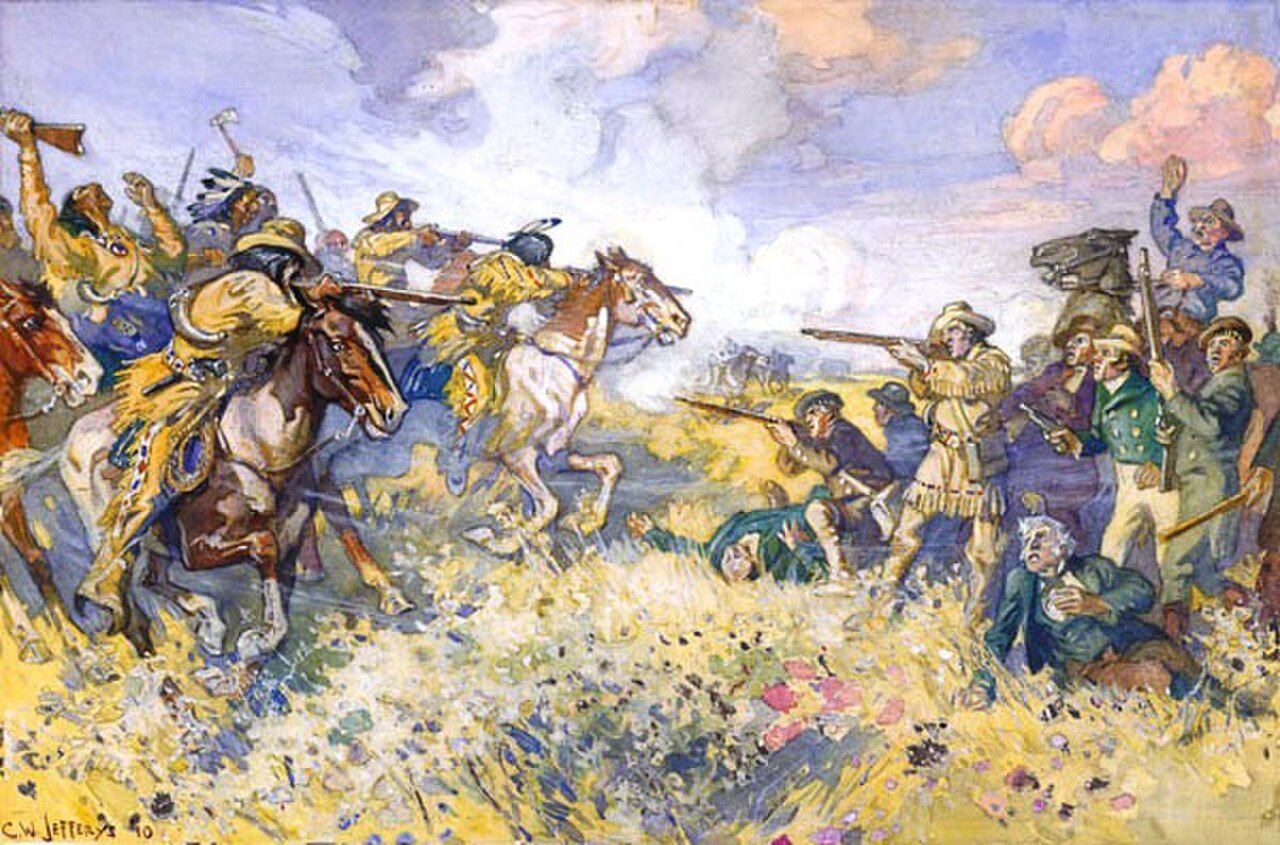
It lasted about fifteen minutes.
When it was over, a governor lay dead on a frog plain a few miles north of the Forks, his young colony was about to scatter — and a people who had never before stood up under their own flag had announced themselves to history.
The place is a quiet Winnipeg neighbourhood today. In 1816, it was the flashpoint of a war fought over food.
A colony planted in someone else’s country
In 1812, a Scottish lord — Thomas Douglas, Earl of Selkirk — planted a farming colony where Winnipeg now stands, on land granted to the Hudson’s Bay Company. The Red River Settlement was meant to feed the fur trade and give displaced Scottish families a new start.
But the land was not empty. Métis families — the children of fur traders and Indigenous mothers, with their own language, laws and way of life — had hunted and traded there for generations. Their economy ran on pemmican: dried buffalo meat pounded with fat and berries, the fuel that powered the whole fur trade.
In 1814, the colony’s governor, Miles Macdonell, issued the Pemmican Proclamation, banning the export of food from the colony. To the Hudson’s Bay Company, it was survival. To the Métis and the rival North West Company, it was a declaration of war on their livelihood. The Pemmican War had begun.
Two companies, one river
Through 1815 and into 1816 the conflict escalated: seizures, arrests, shots exchanged. In March 1816, Hudson’s Bay men seized and demolished Fort Gibraltar, the North West Company post at the Forks. Robert Semple, an American businessman with no fur-trade experience, arrived as the colony’s new governor.
Meanwhile, a party of some sixty Métis freighters under Cuthbert Grant — a North West Company clerk from the Qu’Appelle country — was moving a supply of pemmican overland toward Lake Winnipeg, deliberately steering wide of the Forks to avoid the colony’s fort.
On June 19, 1816, the two parties met near a grove the Métis called La Grenouillère — Frog Plain — known in English as Seven Oaks.
Fifteen minutes
Semple rode out from Fort Douglas with fewer than thirty men to confront them. Words were exchanged — sharp ones. Then a shot. Whose shot came first has been argued ever since; an official inquiry two years later could not settle it to everyone’s satisfaction, and historians still debate it.
What is not debated is the result. In about fifteen minutes of gunfire, twenty-one of Semple’s party were killed, including Semple himself. Grant’s side lost one man.
Grant then took Fort Douglas, and the surviving colonists abandoned the settlement and headed north. The Red River Colony had effectively ceased to exist — for the second time in its short, violent life.
Why a quarter-hour fight still matters
The colony came back the following year, and Lord Selkirk himself arrived with soldiers. But Seven Oaks changed things that could not be undone:
- The fur trade’s war burned itself out. Five years later, in 1821, the two exhausted rivals were merged into one company under the Hudson’s Bay name. The age of company-against-company violence was over.
- The Métis stood up as a nation. Seven Oaks is remembered in Métis tradition as the Victory of the Frog Plain — one of the first times the Métis asserted themselves as la Nouvelle Nation, the New Nation, under their own flag. That identity, announced in 1816, runs in a straight line to Louis Riel and the birth of Manitoba half a century later.
The battlefield is a National Historic Site of Canada (designated in 1920), marked by a monument in Winnipeg’s West Kildonan, in the neighbourhood that still carries its name: Seven Oaks.
Fifteen minutes. One governor, one flag, one nation announcing itself. Winnipeg was built on ground where that had already happened, a lifetime before the city had a name.
Have you ever passed the Seven Oaks monument without knowing what it marks?
Keep exploring:
- The Secret Tunnels Under Downtown Winnipeg: Legend, Concrete and the Real Underground
- The Winnipeg General Strike of 1919: The Six Weeks a City Shut Down
- Manitoba Legislative Building: Fossils, Secrets and the Golden Boy
Sources: Encyclopaedia Britannica (“Seven Oaks Massacre”) · Manitoba Historical Society, “Reflections on the Battle of Seven Oaks” · Wikipedia, “Battle of Seven Oaks” (cross-checked against the two sources above; casualty counts follow the commonly cited figures: 21 dead on Semple’s side, 1 on Grant’s; party sizes are given as ranges because sources vary between ~60–65 and ~24–28)
Image credits: “The Fight at Seven Oaks,” illustration by Charles William Jefferys — public domain, via Wikimedia Commons.
Leave a Reply